





In-Home Speech Therapy in Tampa, FL
What Is In-Home Speech Therapy?
Our Speech Therapy Services
Speech Therapy Services We Provide at Home
Comprehensive Speech-Language Evaluation
Every course of speech therapy begins with a thorough evaluation of your speech, language, voice, swallowing, and cognitive-communication abilities. Your SLP assesses articulation, fluency, voice quality, oral motor function, receptive and expressive language skills, reading, writing, and swallowing safety. This evaluation identifies the specific deficits affecting your communication and establishes a targeted treatment plan with measurable goals.
Dysphagia (Swallowing Disorder) Treatment
Dysphagia — difficulty swallowing — is one of the most common and potentially dangerous conditions treated by speech therapists. Swallowing problems can lead to choking, aspiration pneumonia, malnutrition, and dehydration. Our SLPs evaluate your swallowing function, determine safe food and liquid textures, teach swallowing techniques and exercises to strengthen the muscles involved, and educate patients and caregivers on safe eating strategies. Dysphagia treatment is critical for patients recovering from stroke, head and neck surgery, neurological diseases, and prolonged intubation.
Speech Articulation Therapy
Articulation disorders affect the clarity of speech — making it difficult for others to understand what you’re saying. After a stroke, brain injury, or surgery affecting the mouth, tongue, or jaw, patients may slur words, substitute sounds, or struggle to form certain consonants and vowels. Our SLPs use targeted exercises to strengthen the oral muscles involved in speech, improve tongue and lip coordination, and restore clear, intelligible communication.
Comprehensive Speech-Language Evaluation
Every course of speech therapy begins with a thorough evaluation of your speech, language, voice, swallowing, and cognitive-communication abilities. Your SLP assesses articulation, fluency, voice quality, oral motor function, receptive and expressive language skills, reading, writing, and swallowing safety. This evaluation identifies the specific deficits affecting your communication and establishes a targeted treatment plan with measurable goals.
Dysphagia (Swallowing Disorder) Treatment
Dysphagia — difficulty swallowing — is one of the most common and potentially dangerous conditions treated by speech therapists. Swallowing problems can lead to choking, aspiration pneumonia, malnutrition, and dehydration. Our SLPs evaluate your swallowing function, determine safe food and liquid textures, teach swallowing techniques and exercises to strengthen the muscles involved, and educate patients and caregivers on safe eating strategies. Dysphagia treatment is critical for patients recovering from stroke, head and neck surgery, neurological diseases, and prolonged intubation.
Speech Articulation Therapy
Articulation disorders affect the clarity of speech — making it difficult for others to understand what you’re saying. After a stroke, brain injury, or surgery affecting the mouth, tongue, or jaw, patients may slur words, substitute sounds, or struggle to form certain consonants and vowels. Our SLPs use targeted exercises to strengthen the oral muscles involved in speech, improve tongue and lip coordination, and restore clear, intelligible communication.
Language Disorder Treatment
Language disorders affect the ability to understand others (receptive language) or express thoughts through words and sentences (expressive language). Aphasia — a language disorder most commonly caused by stroke — can range from mild word-finding difficulty to a near-complete loss of the ability to speak or comprehend language. Our SLPs provide structured language therapy using evidence-based techniques to rebuild vocabulary, sentence formation, reading, writing, and conversational skills. We also train family members on communication strategies to support the patient between sessions.
Language Disorder Treatment
Language disorders affect the ability to understand others (receptive language) or express thoughts through words and sentences (expressive language). Aphasia — a language disorder most commonly caused by stroke — can range from mild word-finding difficulty to a near-complete loss of the ability to speak or comprehend language. Our SLPs provide structured language therapy using evidence-based techniques to rebuild vocabulary, sentence formation, reading, writing, and conversational skills. We also train family members on communication strategies to support the patient between sessions.
Voice Disorder Treatment
Voice disorders affect the pitch, volume, quality, or resonance of your voice. Conditions like vocal cord paralysis, vocal nodules, laryngeal surgery, and neurological diseases (such as Parkinson’s) can cause a weak, hoarse, breathy, or strained voice. Our SLPs provide voice therapy exercises to improve vocal cord function, breath support, and vocal projection. For Parkinson’s patients, we offer techniques specifically designed to increase vocal loudness and clarity.
Cognitive-Communication Therapy
Cognitive-communication disorders affect the thinking skills that underpin communication — attention, memory, organization, problem-solving, and reasoning. These disorders are common after stroke, traumatic brain injury, and in progressive neurological conditions like dementia. Our SLPs use structured exercises and real-world tasks to improve cognitive-communication skills, helping patients participate more effectively in conversations, follow directions, manage daily tasks, and maintain social connections.
Voice Disorder Treatment
Voice disorders affect the pitch, volume, quality, or resonance of your voice. Conditions like vocal cord paralysis, vocal nodules, laryngeal surgery, and neurological diseases (such as Parkinson’s) can cause a weak, hoarse, breathy, or strained voice. Our SLPs provide voice therapy exercises to improve vocal cord function, breath support, and vocal projection. For Parkinson’s patients, we offer techniques specifically designed to increase vocal loudness and clarity.
Cognitive-Communication Therapy
Cognitive-communication disorders affect the thinking skills that underpin communication — attention, memory, organization, problem-solving, and reasoning. These disorders are common after stroke, traumatic brain injury, and in progressive neurological conditions like dementia. Our SLPs use structured exercises and real-world tasks to improve cognitive-communication skills, helping patients participate more effectively in conversations, follow directions, manage daily tasks, and maintain social connections.
Dysphasia Treatment
Dysphasia (also known as aphasia) is a language impairment that affects the ability to produce or understand spoken and written language. It is most commonly caused by stroke but can also result from brain tumors, traumatic brain injury, or progressive neurological disease. Our SLPs provide intensive, individualized language therapy to help patients recover as much language function as possible, while also teaching compensatory communication strategies — such as gesture, writing, or communication devices — for residual deficits.
Aural Rehabilitation
Aural rehabilitation helps patients with hearing loss improve their ability to communicate effectively. Our SLPs work with patients who use hearing aids or cochlear implants, providing auditory training, speechreading (lip reading) techniques, communication strategy education, and environmental modification recommendations. We also counsel family members on how to communicate more effectively with a hearing-impaired loved one — such as reducing background noise, facing the person while speaking, and using visual cues.
Dysphasia Treatment
Dysphasia (also known as aphasia) is a language impairment that affects the ability to produce or understand spoken and written language. It is most commonly caused by stroke but can also result from brain tumors, traumatic brain injury, or progressive neurological disease. Our SLPs provide intensive, individualized language therapy to help patients recover as much language function as possible, while also teaching compensatory communication strategies — such as gesture, writing, or communication devices — for residual deficits.
Aural Rehabilitation
Aural rehabilitation helps patients with hearing loss improve their ability to communicate effectively. Our SLPs work with patients who use hearing aids or cochlear implants, providing auditory training, speechreading (lip reading) techniques, communication strategy education, and environmental modification recommendations. We also counsel family members on how to communicate more effectively with a hearing-impaired loved one — such as reducing background noise, facing the person while speaking, and using visual cues.
Conditions We Treat
Conditions Our Tampa Speech Therapists Treat At Home
Our in-home speech therapy services help patients with a wide range of diagnoses:
Stroke (aphasia, dysarthria, dysphagia, cognitive-communication deficits)
Traumatic brain injury
Parkinson’s disease (voice, swallowing, and cognitive-communication)
Dementia and Alzheimer’s disease (communication maintenance and safety)
Head and neck cancer (post-surgical speech and swallowing rehabilitation)
ALS, multiple sclerosis, and other progressive neurological conditions
Vocal cord paralysis or vocal cord surgery
Laryngectomy rehabilitation
Dysphagia from prolonged intubation or ventilator use
Hearing loss and cochlear implant rehabilitation
Tracheostomy communication and swallowing management
When to Seek Speech Therapy
Signs That You or a Loved
One May Need Speech Therapy
Speech, language, and swallowing problems are not always obvious. Contact your physician or call Empower Home Care if you or a family member is experiencing any of the following:
Slurred, unclear, or difficult-to-understand speech
Difficulty finding words or forming sentences
Trouble understanding what others are saying
Coughing, choking, or a wet-sounding voice during or after eating and drinking
Food or liquid “going down the wrong pipe” frequently
Unexplained weight loss or dehydration (may indicate swallowing problems)
A voice that sounds weak, hoarse, breathy, or strained
Difficulty reading, writing, or following conversations
Memory, attention, or problem-solving issues affecting daily communication
Difficulty using a hearing aid or cochlear implant effectively
What to Expect From
In-Home Speech Therapy

Physician Referral
Speech therapy requires a physician’s order. Your doctor, neurologist, ENT specialist, or hospital discharge planner can refer you to Empower Home Care. You can also call us and we’ll coordinate the referral with your physician.

Initial SLP Evaluation
Your speech-language pathologist visits your home for a comprehensive evaluation of your speech, language, voice, swallowing, and cognitive-communication abilities. They assess your current function, identify specific deficits, and develop an individualized treatment plan with clear, measurable goals.

Treatment Sessions
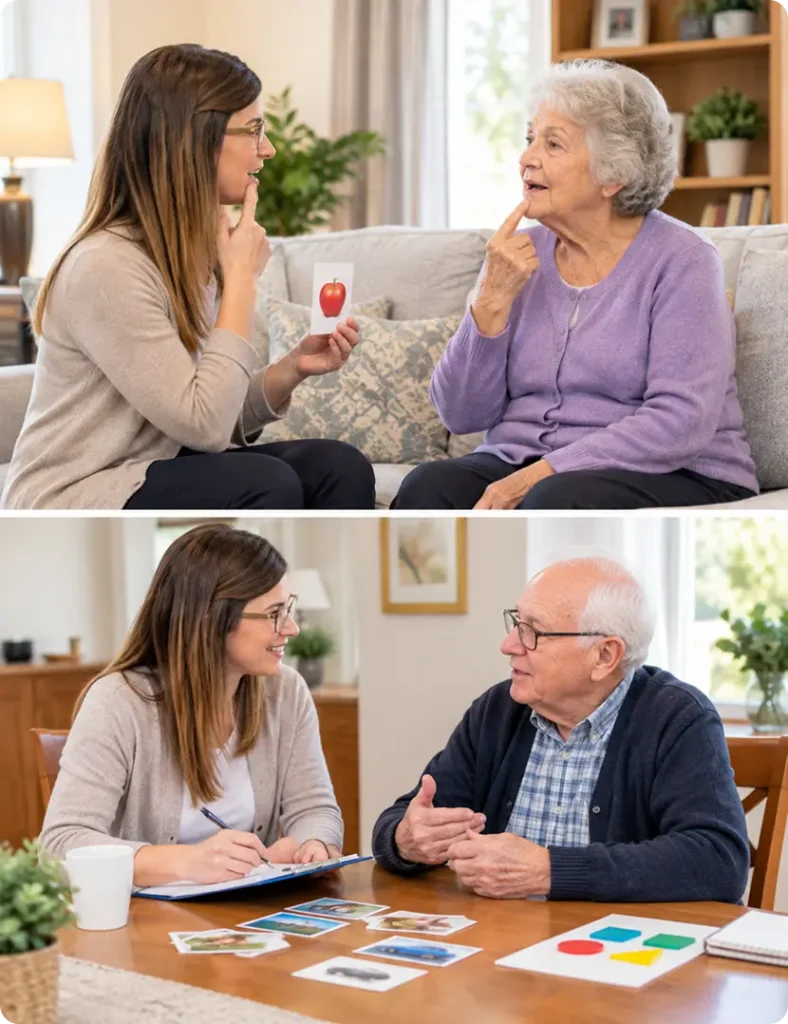
Sessions typically last 45 to 60 minutes and occur one to three times per week. Each session includes targeted exercises, functional practice using real-life tasks and materials, patient and caregiver education, and progress monitoring. Your SLP adjusts the treatment plan as your abilities improve.

Caregiver Training & Discharge
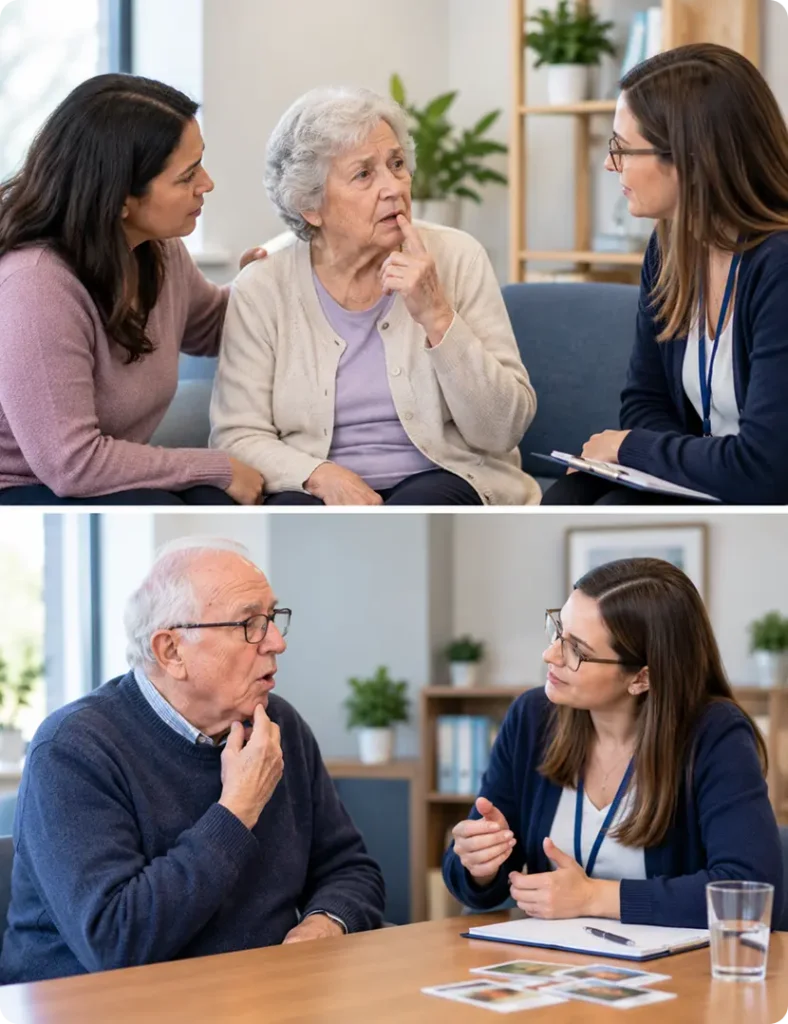
Throughout treatment, your SLP trains family members and caregivers on communication strategies, safe swallowing practices, and exercises to continue between visits. When your therapy goals are met, you’re discharged with a home program and the skills to maintain your progress independently.

Physician Referral
Speech therapy requires a physician’s order. Your doctor, neurologist, ENT specialist, or hospital discharge planner can refer you to Empower Home Care. You can also call us and we’ll coordinate the referral with your physician.

Initial SLP Evaluation
Your speech-language pathologist visits your home for a comprehensive evaluation of your speech, language, voice, swallowing, and cognitive-communication abilities. They assess your current function, identify specific deficits, and develop an individualized treatment plan with clear, measurable goals.

Treatment Sessions
Sessions typically last 45 to 60 minutes and occur one to three times per week. Each session includes targeted exercises, functional practice using real-life tasks and materials, patient and caregiver education, and progress monitoring. Your SLP adjusts the treatment plan as your abilities improve.

Caregiver Training & Discharge
Throughout treatment, your SLP trains family members and caregivers on communication strategies, safe swallowing practices, and exercises to continue between visits. When your therapy goals are met, you’re discharged with a home program and the skills to maintain your progress independently.
Why Choose Empower
Why Tampa Patients Choose Empower for Speech Therapy

Licensed Speech-Language Pathologists
Our SLPs hold master’s degrees and have specialized experience in adult neurological, voice, swallowing, and cognitive-communication rehabilitation.

Therapy in Your Home Environment
Practicing speech and swallowing skills with your own meals, phone, and daily routines produces faster, more functional results.

Nurse-Owned & CHAP Accredited
Speech therapy is delivered as part of a clinician-led, quality-accredited home health care program.

Coordinated Multidisciplinary Team
Your SLP collaborates with our nurses, PTs, OTs, and aides for comprehensive recovery.

Family & Caregiver Education
We train your family on communication strategies and swallowing safety so they can support you effectively.

Three-County Coverage
In-home speech therapy across Hillsborough, Manatee, and Polk counties.
Insurance & Medicare
Is In-Home Speech Therapy Covered by Insurance?
Yes. In-home speech therapy is covered by Medicare, Medicaid, and most private insurance plans when ordered by a physician and provided by a certified home health agency. Medicare Part A covers home health speech therapy with no copay when the patient is homebound and needs skilled, intermittent care. Empower Home Care is Medicare certified. Our intake team verifies your insurance coverage before services begin. Call (813) 652-7070 for a free benefits check.
Where We Provide
In-Home Speech Therapy
Hillsborough County
Tampa, Brandon, Riverview, Plant City, Carrollwood, Temple Terrace, Valrico, Lutz, Sun City Center, New Tampa, and North Tampa.
Manatee County
Bradenton, Palmetto, Lakewood Ranch, Parrish, Ellenton, Anna Maria, Holmes Beach, Longboat Key, and surrounding areas.
Polk County
Lakeland, Winter Haven, Bartow, Haines City, Auburndale, Davenport, Lake Alfred, Dundee, Eagle Lake, and surrounding areas.
Hillsborough County
Tampa, Brandon, Riverview, Plant City, Carrollwood, Temple Terrace, Valrico, Lutz, Sun City Center, New Tampa, and North Tampa.
Manatee County
Bradenton, Palmetto, Lakewood Ranch, Parrish, Ellenton, Anna Maria, Holmes Beach, Longboat Key, and surrounding areas.
Polk County
Lakeland, Winter Haven, Bartow, Haines City, Auburndale, Davenport, Lake Alfred, Dundee, Eagle Lake, and surrounding areas.
Frequently Asked Questions
About In-Home Speech Therapy
What is the difference between a speech therapist and a speech-language pathologist?
Can speech therapy help someone who had a stroke?
How does swallowing therapy work at home?
Your SLP evaluates your swallowing function, determines which food and liquid textures are safe, teaches specific swallowing techniques and exercises to strengthen the muscles involved, and educates you and your caregivers on safe eating positions and strategies. Treatment sessions often include practicing with actual meals in your kitchen, which makes the therapy immediately practical.
Can speech therapy help with Parkinson’s disease?
How long does speech therapy typically take?
Will my family learn how to help me between speech therapy visits?
Start In-Home Speech Therapy in Tampa Today

Phone:
(813) 652-7070
Referral Fax : (866) 728-0013

info@empowerhomecare.net

Home Office
10002 Princess Palm Ave, Suite 100, Tampa, FL 33619