
Parkinson’s Disease Home Care In Tampa, FL
How Home Care Supports Parkinson’s Disease Patients
Why Parkinson’s Patients Need
Specialized Home Care

Motor Symptoms & Mobility
Bradykinesia (slowed movement), rigidity, tremor, and postural instability are the hallmark motor symptoms of PD. These symptoms cause difficulty walking, turning, standing from seated positions, getting in and out of bed, and navigating tight spaces. Falls are extremely common — and extremely dangerous — for PD patients. Freezing of gait, where a patient’s feet suddenly feel “glued to the floor,” is one of the most frightening and fall-producing symptoms. Our physical therapists use evidence-based techniques specific to Parkinson’s, including cueing strategies (visual, auditory, and tactile cues to initiate movement), amplitude training, and progressive balance programs.

Speech & Swallowing Decline
Parkinson’s commonly causes hypophonia (soft, quiet voice), monotone speech, and articulation difficulties that make it increasingly hard for patients to be understood. Dysphagia (swallowing difficulty) is another serious PD complication that increases the risk of aspiration pneumonia — a leading cause of hospitalization and death in Parkinson’s patients. Our speech-language pathologists provide voice therapy techniques specifically designed for PD, such as LSVT-based approaches that focus on increasing vocal loudness and effort. They also assess swallowing function and implement safe eating strategies.

Medication Complexity
Parkinson’s medication regimens are among the most complex of any chronic condition. Levodopa/carbidopa, dopamine agonists, MAO-B inhibitors, COMT inhibitors, and other medications must be taken at precise times — sometimes with food, sometimes without, sometimes hours apart from other drugs. Timing matters enormously: a dose taken 30 minutes late can mean the difference between functional mobility and a frozen, immobile episode. Our skilled nurses help patients and caregivers manage these complex schedules, monitor for side effects (including dyskinesias, hallucinations, and orthostatic hypotension), and coordinate with the patient’s neurologist.

Non-Motor Symptoms
Many families are surprised to learn that Parkinson’s also causes depression, anxiety, apathy, cognitive decline, sleep disturbances, constipation, urinary issues, and orthostatic hypotension (sudden drops in blood pressure when standing). These non-motor symptoms can be as disabling as the motor symptoms and are often undertreated. Our nursing team monitors for these symptoms, educates patients and families, and communicates concerns to the neurologist. Our medical social workers provide counseling for the depression and anxiety that commonly accompany PD.

Cognitive Changes & Dementia
Cognitive impairment affects a significant percentage of Parkinson’s patients, and Parkinson’s disease dementia (PDD) eventually develops in many cases. Cognitive changes can include slowed thinking, difficulty with multitasking, executive function impairment, and eventually more significant memory and reasoning deficits. Our occupational therapists and speech therapists provide cognitive exercises and structured daily routines that support remaining cognitive abilities. Our team also helps families plan for the progressive nature of PDD.

Caregiver Burden
Caring for a Parkinson’s patient is physically and emotionally exhausting. As the disease progresses, caregivers take on increasingly demanding responsibilities — helping with transfers, managing medications, preparing specialized meals, assisting with bathing and dressing, and providing constant fall supervision. Caregiver burnout, depression, and health decline are common. Our home health aides provide scheduled relief, our medical social workers offer caregiver counseling and connect families with PD support groups, and our clinical team shares the care burden so family caregivers can sustain their role long-term.
How Our Tampa Team Supports
Parkinson’s Patients at Home
Skilled Nursing for Parkinson’s
Medication management and timing optimization, monitoring for side effects (dyskinesias, hallucinations, orthostatic hypotension), fall risk assessment, vital signs monitoring, coordination with your neurologist and movement disorder specialist, disease education for patients and families, and management of co-existing conditions like diabetes, heart disease, and hypertension.
Physical Therapy for Parkinson’s
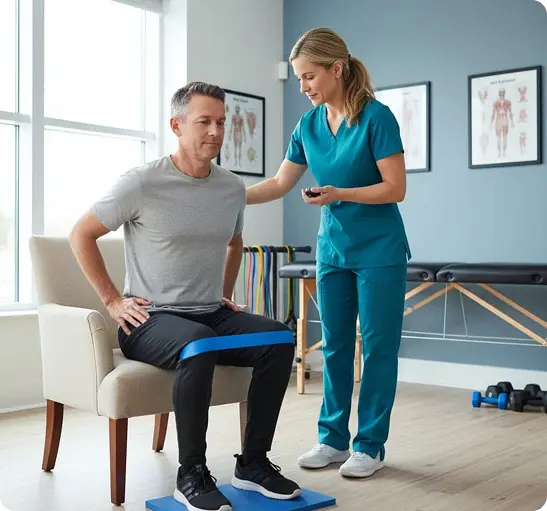
PD-specific exercise programs targeting amplitude of movement, cueing strategies for freezing of gait (floor markers, rhythmic auditory cues, laser cues), progressive balance and strength training, transfer training (bed, chair, toilet, car), fall prevention and home safety modifications, gait training to address shuffling and festination, and postural exercises to counteract the forward-leaning posture common in PD.
Occupational Therapy for Parkinson’s
ADL adaptation for tremor and rigidity (adaptive utensils, button hooks, elastic shoelaces), fine motor exercises for handwriting, dressing, and eating, home safety assessment and modification, cognitive exercises and structured daily routines, energy conservation strategies for fatigue management, and adaptive equipment recommendations.
Skilled Nursing for Parkinson’s
Medication management and timing optimization, monitoring for side effects (dyskinesias, hallucinations, orthostatic hypotension), fall risk assessment, vital signs monitoring, coordination with your neurologist and movement disorder specialist, disease education for patients and families, and management of co-existing conditions like diabetes, heart disease, and hypertension.
Physical Therapy for Parkinson’s
PD-specific exercise programs targeting amplitude of movement, cueing strategies for freezing of gait (floor markers, rhythmic auditory cues, laser cues), progressive balance and strength training, transfer training (bed, chair, toilet, car), fall prevention and home safety modifications, gait training to address shuffling and festination, and postural exercises to counteract the forward-leaning posture common in PD.
Occupational Therapy for Parkinson’s
ADL adaptation for tremor and rigidity (adaptive utensils, button hooks, elastic shoelaces), fine motor exercises for handwriting, dressing, and eating, home safety assessment and modification, cognitive exercises and structured daily routines, energy conservation strategies for fatigue management, and adaptive equipment recommendations.
Speech Therapy for Parkinson’s
Voice therapy using LSVT-based techniques to increase loudness and clarity, articulation exercises, cognitive-communication therapy, swallowing evaluation and dysphagia management, safe eating strategies and texture modification recommendations, and communication partner training for family members.
Speech Therapy for Parkinson’s
Voice therapy using LSVT-based techniques to increase loudness and clarity, articulation exercises, cognitive-communication therapy, swallowing evaluation and dysphagia management, safe eating strategies and texture modification recommendations, and communication partner training for family members.
Medical Social Services for PD Families
Counseling for patients dealing with depression, anxiety, and loss of independence. Caregiver counseling and burnout prevention. Connection to Parkinson’s Foundation support groups and local PD resources in Tampa Bay. Long-term care planning as the disease progresses. Financial assistance navigation. Advance directive assistance.
Home Health Aide for Parkinson’s
Nurse-supervised personal care with PD-specific training: safe bathing assistance (accounting for tremor, rigidity, and balance), dressing assistance using adaptive techniques, meal preparation following any dietary or swallowing guidelines, mobility and transfer assistance, medication reminders, and companionship. Our aides are trained to work patiently with PD patients, allowing extra time for tasks and encouraging independence wherever possible.
Medical Social Services for PD Families
Counseling for patients dealing with depression, anxiety, and loss of independence. Caregiver counseling and burnout prevention. Connection to Parkinson’s Foundation support groups and local PD resources in Tampa Bay. Long-term care planning as the disease progresses. Financial assistance navigation. Advance directive assistance.
Home Health Aide for Parkinson’s
Nurse-supervised personal care with PD-specific training: safe bathing assistance (accounting for tremor, rigidity, and balance), dressing assistance using adaptive techniques, meal preparation following any dietary or swallowing guidelines, mobility and transfer assistance, medication reminders, and companionship. Our aides are trained to work patiently with PD patients, allowing extra time for tasks and encouraging independence wherever possible.
Why Tampa PD Families Choose Empower Home Care

Nurse-Owned Clinical Leadership
Our nurse founders understand the clinical complexity of Parkinson’s and ensure our team is equipped to manage it.

Multidisciplinary PD Approach
Nursing, PT, OT, speech therapy, social work, and aide services coordinated under one plan — essential for a disease that affects every system.

CHAP Accredited
Independently verified quality standards.

Veteran-Operated
Discipline, patience, and reliability in every visit.

PD-Specific Training
Our therapists use evidence-based PD techniques (cueing strategies, amplitude training, LSVT-based voice therapy) not generic rehabilitation.

Caregiver Support
PD caregiver burnout is real. We actively support family caregivers with counseling, education, and scheduled relief.

Neurologist Coordination
We communicate directly with your neurologist or movement disorder specialist about medication adjustments, symptom changes, and care plan updates.

Three-County Coverage
Serving PD patients across Hillsborough, Manatee, and Polk counties.
Supporting Patients at Every
Stage of Parkinson’s Disease

Early Stage (Mild Symptoms)
In the early stages, PD symptoms are present but may not significantly limit daily activities. Home care at this stage focuses on establishing an exercise routine to slow decline, medication education and scheduling, home safety assessment to prevent falls before they happen, and educating patients and families about what to expect as the disease progresses. Early intervention sets the foundation for better outcomes later.

Middle Stage (Moderate Symptoms)
This is often when families first seek home care. Motor symptoms are noticeably affecting daily life — walking is slower and less steady, dressing and bathing take longer, and medication timing becomes critical. Home care at this stage includes regular PT for balance and mobility, OT for daily living adaptations, speech therapy for voice and swallowing, medication management, home health aide for personal care, and caregiver education and support.

Advanced Stage (Significant Disability)
In advanced PD, patients may need assistance with most daily activities, be at high risk for falls, have significant speech and swallowing difficulties, and experience cognitive impairment. Home care becomes more intensive: more frequent nursing and aide visits, increased fall prevention measures, swallowing safety protocols, cognitive support, and enhanced caregiver training and respite. Our team also helps families navigate conversations about long-term care options and advance directives.
Parkinson’s Home
Care Across Tampa Bay
Hillsborough County
Tampa, Brandon, Riverview, Plant City, Carrollwood, Temple Terrace, Valrico, Lutz, Sun City Center, New Tampa, North Tampa, and all surrounding communities.
Manatee County
Bradenton, Palmento, Lakewood Ranch, Parrish, Sarasota, Ellenton, Anna Maria, Holmes Beach, Longboat Key, Cortez, Bayshore Gardens, West Bradenton, and all surrounding communities.
Polk County
Lakeland, Winter Haven, Bartow, Haines City, Auburndale, Davenport, Lake Alfred, Polk City, Highland City, Cypress Gardens, Eagle Lake, and all surrounding communities.
Hillsborough County
Tampa, Brandon, Riverview, Plant City, Carrollwood, Temple Terrace, Valrico, Lutz, Sun City Center, New Tampa, North Tampa, and all surrounding communities.
Manatee County
Bradenton, Palmento, Lakewood Ranch, Parrish, Sarasota, Ellenton, Anna Maria, Holmes Beach, Longboat Key, Cortez, Bayshore Gardens, West Bradenton, and all surrounding communities.
Polk County
Lakeland, Winter Haven, Bartow, Haines City, Auburndale, Davenport, Lake Alfred, Polk City, Highland City, Cypress Gardens, Eagle Lake, and all surrounding communities.
Insurance & Medicare
Is Parkinson’s Home Care Covered by Medicare?
Yes. Home health care services for Parkinson’s disease patients are covered by Medicare Part A when ordered by a physician, the patient is homebound, and skilled intermittent care is needed. This includes skilled nursing, physical therapy, occupational therapy, speech therapy, medical social services, and home health aide — all at no copay or deductible. Empower Home Care is Medicare certified. Many PD patients qualify for ongoing home health care because Parkinson’s is a progressive condition that continually creates new skilled care needs — medication adjustments, therapy for declining function, fall prevention, and swallowing management. Call (813) 652-7070 for a free benefits verification.
Frequently Asked Questions
About Parkinson’s Home Care
When should we start home care for Parkinson’s?
Does Medicare cover home care for Parkinson’s patients?
What is freezing of gait, and can physical therapy help?
Can speech therapy help with Parkinson’s voice problems?
How do you help Parkinson’s caregivers?
Will you coordinate with my loved one’s neurologist?
Can home care help prevent falls for Parkinson’s patients?
Get Specialized Parkinson’s Home Care In Tampa

Phone:
(813) 652-7070
Referral Fax : (866) 728-0013

info@empowerhomecare.net

Home Office
10002 Princess Palm Ave, Suite 100, Tampa, FL 33619